
Construction dust: Risks and legal obligations
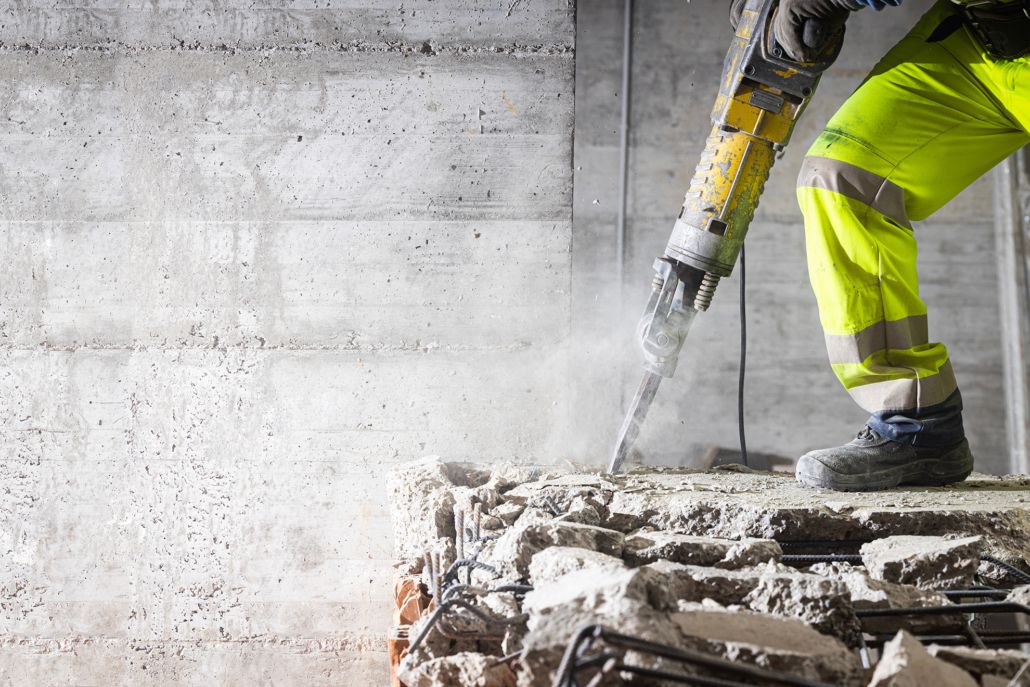
Construction dust is a fine, heterogeneous mixture of particles that is released during construction, renovation and demolition work through mechanical processing such as drilling, grinding or milling.
It originates primarily on construction sites, in industrial plants, and during manual labor, and consists of mineral components such as concrete, cement, and gypsum dust. It often contains hazardous substances such as quartz dust, asbestos fibers, lead particles from old paint layers, or wood dust from processed materials.
Particularly problematic are respirable fine dust particles, which penetrate deep into the respiratory tract and can contribute to diseases such as silicosis, COPD, or lung cancer. In enclosed spaces, construction dust also contributes to fine dust pollution and can remain in the environment long-term due to inadequate extraction or air circulation.
Why is construction dust dangerous?
Construction dust is dangerous because fine particles such as quartz dust, asbestos fibers, and wood dust penetrate deep into the lungs and trigger serious illnesses. Quartz dust on construction sites can cause silicosis and lung cancer (TRGS 559). Asbestos fibers lead to asbestosis and mesothelioma. Wood dust from certain hardwoods increases the risk of nasal cancer.
Heavy metals such as lead or cadmium are neurotoxic, while volatile organic compounds (VOCs) cause respiratory irritation. The danger increases with long-term exposure and the combination of different pollutants.
What are inhalable dusts (E-dusts)?
Inhalable dusts, also known as E-dusts, are particles with a size of 100 µm or less that can enter the body via the respiratory tract. These dusts are generally large enough to be inhaled through the nose and mouth, and are often visible to the naked eye.
Dust particles classified as E-dusts can occur in various industrial working environments, particularly in construction, manufacturing and agricultural industries, where exposure to dust particles is common.
What are respirable dusts (A-dusts)?
Respirable dusts, also known as A-dusts, are particles with a size of no more than 5 µm that can penetrate as far as the alveoli (air sacs) in the lungs. These fine dusts are often generated by the mechanical processing of materials and, due to their small size, are able to penetrate deep into the respiratory tract.
What are ultrafine dusts (U-dust)?
Ultrafine dusts, also known as U-dust, are particles with a size of no more than 100 nm, which are classified as nanoparticles due to their small dimensions. These fine particles are produced, among other things, in welding fumes, polymer fumes, technical soot, and diesel engine emissions.
Furthermore, they play a central role in nanotechnology, which is used in paints, coatings, and varnishes. Due to their minimal size, ultrafine dust particles can penetrate deep into the lungs and enter the bloodstream via the alveoli, potentially having toxic effects on organs, the nervous system, and the immune system.
Legal obligations to reduce dust on construction sites
Dust reduction on construction sites is legally mandated and stems from environmental, occupational safety, and hazardous substance regulations at the federal and state levels. Operators are obligated to minimize dust emissions on construction sites and implement technical protective measures. The legal requirements for dust reduction on construction sites are regulated by:
- Federal Immission Control Act (BImSchG)
- Occupational Health and Safety Act (ArbSchG)
- Hazardous Substances Ordinance (GefStoffV)
- Construction Site Regulations
- Technical rules for hazardous substances (TRGS 500, TRGS 559, TRGS 900)
- Limit values for dust emissions (E-dust, A-dust, quartz dust)
- Federal Immission Control Act (BImSchG) : Construction site operators must ensure that avoidable dust emissions are prevented and unavoidable emissions are reduced to a minimum. The basis for this is the state of the art.
- Occupational Health and Safety Act (ArbSchG) : Employers are obliged to assess hazards from dust and to implement appropriate protective measures for employees.
- State immission control laws (e.g. LImSchG Bln) : State regulations oblige construction site operators to take precautions against harmful environmental impacts caused by dust dispersion.
- Hazardous Substances Ordinance (GefStoffV) : The handling of hazardous dusts, especially quartz-containing or asbestos-containing particles, is strictly regulated. Protective measures must be documented and implemented.
- Construction Site Ordinance : For larger construction sites, a safety and health protection plan (SiGe plan) may be required, which includes measures for dust reduction.
- Technical rules for hazardous substances (TRGS) :
- TRGS 500: Defines general protective measures for dust control.
- TRGS 559: Regulates the handling of mineral dust.
- TRGS 900: Sets occupational exposure limits (e.g. 10 mg/m³ for inhalable dust, 1.25 mg/m³ for respirable dust, 0.05 mg/m³ for quartz dust).
- Obligations of construction site operators : Operators must implement a dust reduction concept, integrate suitable protective measures into construction contracts and minimize dust exposure through technical and organizational measures.
Long-term studies on dust at construction sites
Long-term studies have shown that construction dust significantly increases the risk of respiratory and cardiovascular diseases. The University of Utrecht found a direct link between occupational pulmonary fibrosis and an increased risk of lung cancer.
A study from the University of Michigan showed that an increase in PM2.5 concentration of just 10 µg/m³ can raise mortality from heart disease by up to 13%. Additionally, the University of Southern California found that higher levels of particulate matter lead to an increase in cases of heart failure.
The EU's CAFE program estimates that particulate matter causes 348,000 premature deaths annually. The WHO confirms that even low levels of construction dust are harmful to health, as there is no safe limit for particulate matter. Particularly alarming is the German Research Foundation's classification of silicon dioxide in construction dust as carcinogenic.
Technical solutions for dust extraction on construction sites
Technical solutions for dust control on construction sites include high-performance extraction systems, mobile industrial vacuum cleaners, and compact dust collection systems that effectively minimize dust emissions. Stationary extraction systems like the Dustmaster 20000 offer a volume flow of up to 100,000 m³/h, are designed for continuous operation, and are ATEX-certified for handling explosive dusts.
Mobile industrial vacuum cleaners with power outputs from 1 kW to 90 kW enable flexible dust control and support different filter options for the separation of hazardous particles.
Our high-performance dust extraction solutions from Kaweha effectively minimize dust emissions and improve air quality on construction sites. From stationary high-performance systems to mobile industrial vacuum cleaners, we offer ATEX-certified safety, energy-efficient filtration, and maximum extraction power, creating a clean and healthy working environment on your construction site.
February 3, 2025
