
Cooling lubricants: Types, applications and health protection in metalworking
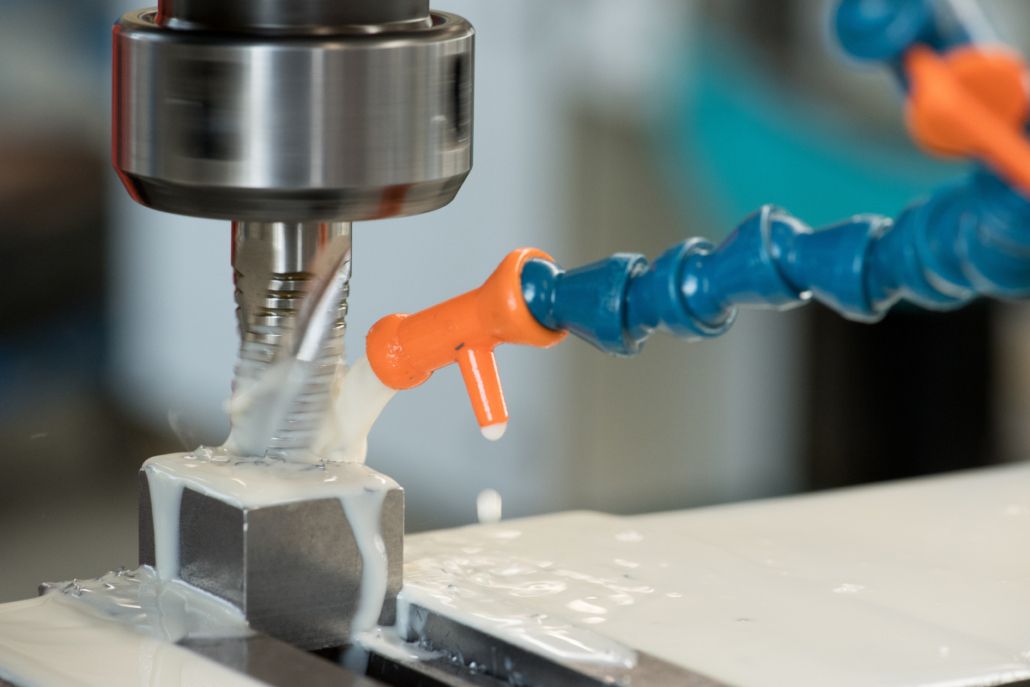
Cooling lubricants are among the indispensable machining media in modern manufacturing. These fluids, also known as coolants or cutting fluids, perform several tasks in machining and forming processes: they cool the tool and workpiece, lubricate the contact zone, and reliably remove chips.
In Germany alone, the metalworking industry consumes around 50,000 tons of these lubricants annually. However, their use also presents challenges, as the resulting mists and fumes endanger the health of employees and require professional extraction systems.
This guide explains the different types of metalworking fluids, their application in machining, and the key measures for occupational safety.
What are cooling lubricants?
Cooling lubricants are liquid or pasty media used between the tool and the workpiece during metalworking. The main function of these machining fluids is to dissipate the heat generated during machining and simultaneously reduce friction.
According to DIN 51385 (the German industrial standard for lubricants), a fundamental distinction is made between non-water-miscible and water-miscible cooling and finishing fluids (CFFs). While non-water-miscible products consist mainly of oils, water-miscible versions are supplied as a concentrate and mixed with water on-site to form an emulsion or solution. The oil content in these emulsions is usually between 5 and 8 percent.
Functions of cooling lubricants in manufacturing
Coolants and lubricants (CSS) fulfill several functions simultaneously in industrial production. The combination of cooling and lubrication makes them a key element for high-quality machining results.
1. Cooling of tool and workpiece
The cooling effect prevents overheating of the machining zone. With water-miscible coolants and lubricants, heat dissipation is determined almost exclusively by the water. The high heat capacity of the water component ensures that temperatures are quickly dissipated from the point of contact. This protects the microstructure in the surface layers of the tool and workpiece from undesirable changes and improves the dimensional accuracy of the manufactured parts.
2. Lubrication and friction reduction
The lubricating effect of coolant significantly reduces friction between the tool and the workpiece. This reduces tool wear and considerably extends the service life of the tools used. Due to their higher viscosity, non-water-miscible lubricants often have a better lubricating effect than water-miscible versions. The choice of additives largely determines the properties and the range of applications.
3. Chip removal and surface finish
Coolants and lubricants handle the flushing and removal of chips from the machining area. This process prevents chips from accumulating in the cutting zone and damaging the workpiece. At the same time, clean coolants and lubricants ensure a better surface finish on the machined materials and reduce built-up edge formation on the tool.
4. Corrosion protection
Coolants and lubricants (CLMs) must possess excellent corrosion protection properties to prevent corrosion on the workpiece, tool, and machine tool surfaces. Special corrosion inhibitors form a protective film on the metal surfaces, thus preventing oxidative damage.
Types of cooling lubricants
Cooling lubricants are primarily classified into two main groups according to DIN 51385. Both categories have specific advantages and disadvantages for different applications in metalworking.
1. Non-water-miscible cooling lubricants
Non-water-miscible metalworking fluids (MWFs) consist mainly of oils such as cutting oils, honing oils, and grinding oils. These are mostly naphthenic or paraffin-based mineral oils, less frequently synthetic oils such as hydrocracked oils (base oils refined by high-pressure hydrogen treatment) or ester oils (synthetic lubricants based on organic acids).
These products are primarily used when a high level of lubrication is required. For simple machining operations, pure mineral oil is sufficient; however, phosphorus or sulfur additives are usually added to enhance performance.
2. Water-miscible cooling lubricants
Water-miscible coolants are supplied as a concentrate and mixed with water on site. These variants offer good heat dissipation but lower lubricating properties compared to pure oils. Mineral oil-based water-miscible coolants contain emulsifiers as well as additives for improved lubrication. The stability of water-soluble products is influenced by water quality.
Within the water-miscible group, a further distinction is made:
- Emulsions: Oil-in-water mixtures stabilized by emulsifiers
- Semi-synthetic cooling fluids: A mixture of emulsion and water-soluble solution
- Synthetic solutions: Water-soluble concentrates that form a clear, oil-free solution when mixed with water.
Components and additives
In addition to base oil or water, cooling lubricants contain various additives that specifically improve their properties. EP additives (Extreme Pressure Additives) react with the workpiece material at high pressures and temperatures, thereby preventing surface roughness peaks.
AW additives (antiwear additives) form an adhesive film on the surface of the tool and workpiece.
Other typical ingredients include defoamers, biocides for preservation, stabilizers, and corrosion inhibitors. Metalworking fluids and their preparations are generally considered mixtures within the meaning of the CLP Regulation (European regulation on the classification, labelling and packaging of substances); therefore, safety data sheets must be provided.
Application areas in metalworking
Cooling lubricants are used in a wide variety of machining methods. The choice of the appropriate product depends on the material, process, and equipment technology.
1. Machining operations
In machining processes such as turning, drilling, milling, broaching, and sawing, coolants are indispensable. The high cutting speeds generate considerable heat, which, without adequate cooling, leads to tool damage and dimensional deviations. In grinding, coolants require excellent flushing properties and corrosion protection to reliably remove fine grinding particles. Honing and lapping also require special lubricants with adapted viscosities.
2. Transformation
In forming processes such as deep drawing, stamping, or rolling, cooling lubricants reduce friction between the tool and the material. This lubrication enables higher forming degrees and protects sensitive workpiece surfaces from damage.
3. Material-specific application
The choice of the appropriate product also depends on the material being machined. Aluminum is often machined with water-soluble coolants that provide good cooling and do not leave stains. Steel and cast iron require different lubricants depending on the machining process. When machining cast iron, bronze, brass, and thermosets, compressed air is generally used instead of liquid coolants.
Health risks and occupational safety
The use of metalworking fluids (MWFs) involves health risks that must be minimized through appropriate protective measures. A risk assessment is legally required for work involving MWFs.
Workplace emissions
High tool speeds and temperatures cause cooling lubricants to disperse as fine particles in the air. These aerosols and vapors can cause health problems with prolonged exposure. Workplace air pollution must be monitored and, if necessary, reduced. For water-miscible cooling lubricants used in metalworking, the state of the art according to DGUV Regulation 109-003 specifies an assessment threshold of 10 mg/m³ as the sum of vapors and aerosols.
Skin irritation and infection risks
Cooling lubricants can cause health problems in workers who come into contact with them. In addition to frequently occurring skin irritations and inflammations, allergic reactions can also occur. Water-miscible cooling lubricants are particularly susceptible to microbial contamination by bacteria and fungi, which can lead to further health problems. The German Biological Agents Ordinance (Biostoffverordnung) must be observed during their use.
Extraction as a protective measure
To keep the concentration of metalworking fluid (MWF) emissions below the assessment thresholds, the use of extraction systems is essential in many cases. Oil mist separators and emulsion mist separators capture the contaminated air directly at the source and clean it using multi-stage filter systems.
These air handling measures protect the health of employees and simultaneously improve workplace quality. Professional oil mist extraction is particularly necessary for CNC machining centers and production lines with high emission levels.
Maintenance and care of cooling lubricants
Regular inspection is essential to ensure that coolant remains effective for a long time. The change intervals vary from a few weeks to several years, depending on operating conditions and maintenance.
Monitoring and control
The appearance and odor of the cooling lubricants must be checked daily. According to TRGS 611 (Technical Rules for Hazardous Substances on restrictions of use for water-miscible cooling lubricants), the pH value and nitrite content must be checked at least weekly.
DGUV Regulation 109-003 additionally recommends weekly monitoring of the metalworking fluid (MWF) concentration. A microbial count can be useful as a supplement, but is not mandatory. During extended work breaks, bacteria can multiply, resulting in strong odors. To prevent health problems, biocides should be used or thermal disinfection should be carried out.
Filtration and purification
Clean cooling lubricants result in a better surface finish and extend the service life of tools. It is advisable to filter the lubricants to extend their lifespan. Special coolant filters, settling tanks, magnetic separators, and skimmers (oil separators for removing tramp oil) are used for this purpose.
Disposal
The use of cooling lubricants causes environmental pollution; therefore, used or unusable products must be handled or disposed of properly. Disposal may only be carried out by specialized companies and must be documented.
KAWEHA – Your partner for the extraction of cooling lubricant mists
With over 30 years of experience in extraction and air filtration technology, KAWEHA offers customized solutions for capturing coolant emissions. Our oil mist separators, such as the Oilmaster OM R, achieve separation efficiencies of up to 99.95 percent and handle volume flows of up to 100,000 m³/h.
Whether you need a stationary system for production lines or a mobile solution for flexible deployment, we will work with you to develop the right concept for your application. Benefit from our expertise and contact us for a personalized consultation. Learn more about our extraction solutions for oil and emulsion mists and protect your employees from harmful emissions.
Frequently asked questions (FAQ)
What is the difference between water-miscible and non-water-miscible cooling lubricants?
Water-miscible cooling fluids are supplied as a concentrate and mixed with water on-site to form an emulsion. These variants offer good heat dissipation but lower lubricating properties. Non-water-miscible lubricants consist mainly of oils and offer higher lubricating properties but less effective cooling.
Why do cooling lubricants need to be extracted?
High rotational speeds and temperatures produce coolant mist and vapors that are harmful to health. Professional extraction keeps the concentration below acceptable levels, protects employees, and prevents deposits on machines and floors.
How often do cooling lubricants need to be changed?
The replacement intervals vary depending on the application, ranging from a few weeks to several years. Regular monitoring of concentration, pH value, and nitrite content is crucial, in accordance with TRGS 611 and DGUV Regulation 109-003. If strong odors or discoloration occur, the coolant should be replaced promptly.
What additives do cooling lubricants contain?
Metalworking fluids (MWFs) contain various additives such as EP additives (high-pressure additives) for demanding applications, AW additives (wear protection additives), corrosion inhibitors, defoamers, and biocides for preservation. The choice of additives determines the properties and application range.
January 26, 2026
