
Electrostatic oil mist separators
Oil mist is an often underestimated problem in industrial manufacturing. Whether in metalworking or plastics processing, without effective separation technologies, fine oil particles enter the ambient air, negatively impacting both employee health and machine performance. Electrostatic oil mist separators are one way to remove such pollutants. But are they really the best choice?
At KAWEHA, we deliberately rely on mechanical oil mist separators, which are characterized by easy maintenance, robust performance, and long-term efficiency. In this text, we compare both technologies, explain the differences, and show why our mechanical separators are the best solution for a clean and safe environment.
Oil mist separators – various methods
Oil mist separators utilize various technologies to filter fine oil particles from the air and create a clean working environment. Mechanical filtration is one of the most proven methods: Here, oil particles are captured by physical barriers such as deep-bed, bag, or cartridge filters. These filters are robust, efficient, and particularly easy to maintain.
An alternative technology is electrostatic deposition, in which oil particles are electrically charged and then attracted to oppositely charged plates. While electrostatic systems offer high particle efficiency, they require more maintenance and are more prone to deposits.
Another option is centrifugal separation, in which heavier oil particles are separated from the air through rotating movements or cyclone principles. This method is particularly suitable for larger quantities of particles and provides a solid basis for clean air quality in industry.
What is an electrostatic oil mist separator?
An electrostatic oil mist separator filters oil mist from the air by electrically charging oil particles and attracting them to charged plates. Thanks to its two-stage principle – ionization and separation – this technology is well-suited for even the finest particles, down to 0.01 micrometers. Due to their compact design and high separation efficiency, these devices are often used in industries with intensive machining processes. However, caution is advised: electrostatic separators require frequent cleaning for smooth operation and consume more energy. Therefore, modern alternatives such as mechanical oil mist separators exist.
How do electrostatic oil mist separators work?
An electrostatic oil mist separator uses electrical charges to remove oil droplets from the air. First, the oil-laden air is drawn into the separator and passed through an ionization zone, where high-voltage electrodes electrostatically charge the oil particles. The charged particles then pass through a separation zone, where they are attracted to oppositely charged collector plates. The separated oil droplets collect on the plates, flow downwards, and are collected in a reservoir. Finally, the cleaned air exits the separator.
Mechanical oil mist separator: The high-performance alternative
Instead of relying on complex technologies, mechanical oil mist separators utilize robust physical barriers such as filter media. This translates to less maintenance, more stable performance, and excellent adaptability to diverse industrial processes. Compared to electrostatic separators, mechanical systems impress with their ease of use and low sensitivity to high particle loads. Whether for CNC machines, grinding processes, or other applications, mechanical oil mist separators stand out due to their reliability, durability, and high separation efficiency. This ensures a clean, safe, and easy-to-maintain workplace.
How does a mechanical oil mist separator work?
A mechanical oil mist separator removes oil particles from the air through physical filtration and coalescence. First, the oil-laden air is drawn in and passes through a coarse filter, which removes larger particles. Next, one or more fine filter media ensure that smaller oil droplets are separated – depending on the particle size, either by impaction, interception, or diffusion. In the next step, small droplets coalesce on the filter fibers to form larger droplets, which then flow downwards due to gravity and are collected in a container. Finally, the cleaned air is safely released back into the environment.
Electrostatic vs. mechanical methods for oil separation
Electrostatic and mechanical oil mist separators are two completely different approaches to air purification. Electrostatic separators can remove even the finest oil droplets from the air, making them quite useful in certain applications. However, their technology requires regular cleaning of the collector plates and higher energy consumption.
Mechanical oil mist separators, on the other hand, rely on robust filter media. These systems are particularly efficient with coarser oil mist, require less energy, and are easier to maintain. Furthermore, they deliver consistent performance even under high particle loads and are less prone to technical failures – a clear advantage in many industrial environments!
Advantages of mechanical oil mist separators compared to electrostatic ones:
- Lower energy consumption
- Easier maintenance thanks to straightforward filter changes
- Stable performance under high particle load
- Robust and less prone to malfunctions
Why KAWEHA relies on mechanical oil mist separators
At KAWEHA, efficiency, durability, and ease of use are paramount – which is why our manufacturers consistently rely on mechanical oil mist separators. With our many years of expertise, we develop high-performance extraction solutions characterized by low maintenance and high reliability. Our Oilmaster series is a prime example of this philosophy: it combines robust filter technology with innovative design and is already being used successfully in numerous industrial sectors.
Whether in CNC machines, metalworking, or the food industry – KAWEHA oil mist separators are used wherever clean air and an uninterrupted production process are essential. Thanks to our customized solutions, our customers benefit from robust and sustainable solutions that prove their worth every day. KAWEHA – because mechanics simply deliver more!
Application areas of oil mist separators
Oil separators are primarily used in industry, as grinding, machining, and hardening processes often produce harmful oil vapors. However, even in plastics processing and textile manufacturing, thermal stress or the use of solvents can generate harmful aerosols and oil mist. Oil mist separators reliably clean the air in all these areas, protecting both people and the environment.
Oil smoke, oil mist: how do they form?
When oils are heated to high temperatures (often above 200°C), the components of the oil evaporate. The high heat breaks chemical bonds in the oil, releasing smaller, volatile molecules. As these vapors cool, they condense into fine droplets, which become visible as oil smoke (oil mist). The main sources of oil smoke are processes such as metalworking (cutting, drilling, milling), the lubrication of hot machine parts, heat treatments, and welding and brazing.
In industrial environments, oil fumes are highly harmful to health – therefore, oil mist separators are used for air purification.
KAWEHA: Your service for clean air and oil mist separators
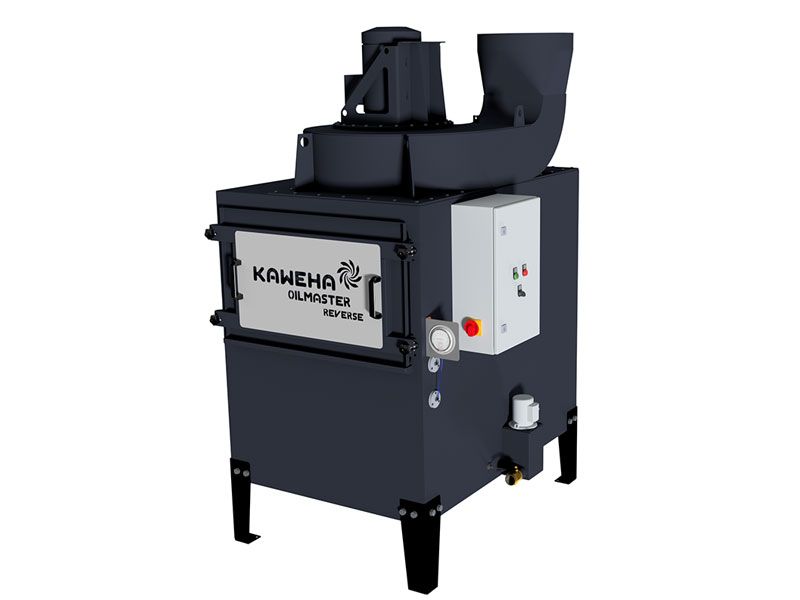
Since 1991, KAWEHA Extraction Technology has stood for mobile and centralized solutions in industrial extraction and air filtration technology. With a focus on developing efficient and robust systems, our portfolio includes the Oilmaster OM Reverse – an oil mist separator that stands out for its high efficiency thanks to its various filter stages. Particularly in metalworking, such as when machining CNC machines, the Oilmaster ensures clean air and reliably removes oil and emulsion mist.
Companies will find flexible and ATEX-certified extraction systems with us; for smoke, fine particles, and emulsions. Would you like to learn more about the Oilmaster OM Reverse or other KAWEHA separators? Then contact us now, and we will find the right solution for your application!
Frequently asked questions (FAQ)
What is an oil mist separator?
An oil mist separator is an extraction system that removes oil droplets and mist from the air. These systems are demonstrably used in industrial areas where oil mist is generated by processes such as metalworking, machine lubrication, or the use of cooling lubricants.
How does mechanical filtration work?
Mechanical oil mist extraction works by using physical barriers to trap oil particles from the air. First, the air passes through a pre-filter that captures coarse particles and larger droplets. Then, the air is passed through finer filter media, where it is subjected to various mechanisms such as impaction, interception, and diffusion. These mechanisms ensure that even smaller oil droplets are captured by the fibers.
What maintenance requirements are there?
Typically, the filters in mechanical oil mist separators need to be replaced or cleaned every 3 to 12 months. Seals should also be checked and replaced if necessary. It is equally important to clean the housing and pipes. Additionally, the oil collection tank must be checked and emptied regularly. With electrostatic oil mist separators, on the other hand, the focus is on the regular cleaning of the collector plates, which is usually done monthly.
February 16, 2025
