
HEPA filters: Structure and function in extraction systems
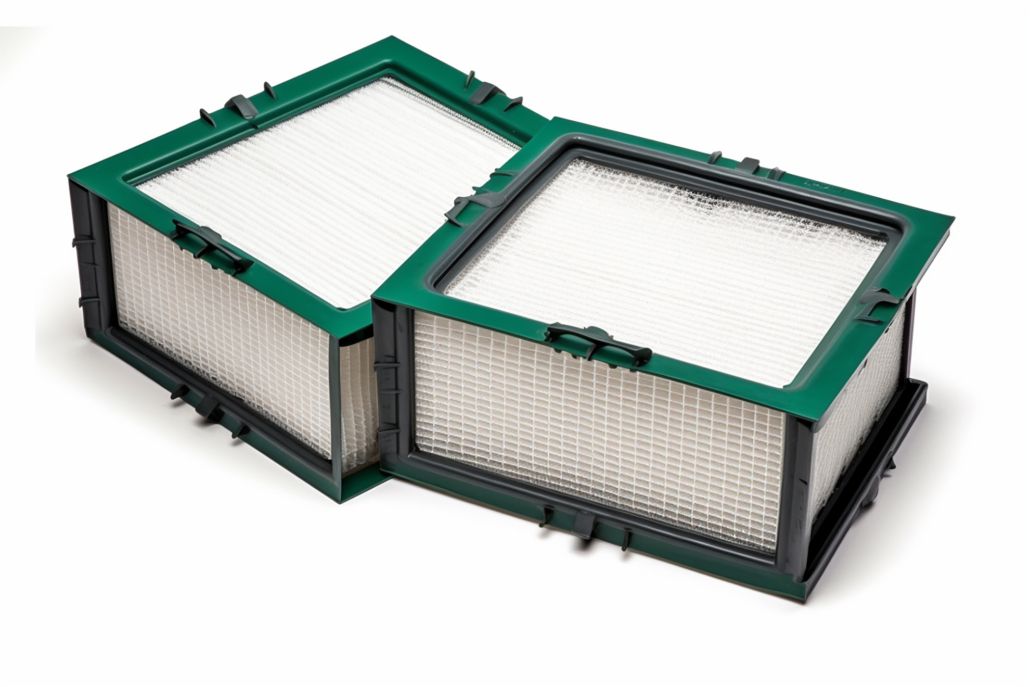
HEPA filters represent the highest filtration efficiency and play a vital role in ensuring clean air. Originally developed to remove hazardous particles, these filters are now indispensable in industrial and household applications. They remove up to 99.97% of particles smaller than 0.3 micrometers, making them ideal for applications in medicine, semiconductor manufacturing, and aerospace. The design and operation of these filters, based on mechanisms such as barrier, inertial, and diffusion effects, ensure thorough particle filtration.
This efficiency originated in the 1940s and has been continuously improved. Standardization guarantees high quality standards, ensuring their use in various sectors. The following text explains the origin, structure, function, and applications of HEPA filters.
What is a HEPA filter?
A HEPA filter (High Efficiency Particulate Air filter) is an air filter that removes fine particles from the air. HEPA filters are used in various fields, including household appliances, medicine, industrial cleanrooms, and aviation. These filters remove dust, pollen, mold spores, bacteria, oil mist, metal dust, and other particles larger than 0.3 micrometers. A HEPA filter removes up to 99.97% of these particles from the air.
HEPA filter setup
A HEPA filter consists of several layers of glass fibers or synthetic materials stacked on top of each other to create maximum filter surface area in a small space. The fibers, with a diameter between 0.5 and 2 micrometers, are randomly arranged to form a mesh that traps particles of varying sizes.
The filter mats are folded and stretched within a frame to ensure even airflow and a large surface area. Some HEPA filters, depending on the material, can be washed and reused.
How a HEPA filter works
The operating principle of a HEPA filter is based on a tightly woven network of randomly arranged glass fibers that filters particles from the air. Unlike a sieve, which sorts particles by size, the irregular structure of a HEPA filter also captures particles smaller than the spaces between the fibers. As air flows past the filter, physical mechanisms such as inertial separation, interception, and diffusion come into play.
These processes make it possible to efficiently remove even the smallest particles such as pollen, bacteria and dust, making the HEPA filter one of the most effective filter systems in fields such as medicine, air purification and semiconductor manufacturing.
Blocking effect
The blocking effect is a mechanism by which HEPA filters function, where particles adhere to the glass fibers due to their proximity. This occurs when particles in the airflow are large enough to flow past the glass fibers but cannot fit through the narrow spaces between them.
The blocking effect is particularly effective for particles in the size range of 0.1 to 1 micrometer. As soon as the particles get too close to the fibers, they adhere to them because their inertia prevents them from passing the filter. This blocking effect enables a HEPA filter to remove 99.97% of particles 0.3 micrometers and larger. In applications requiring clean air, such as hospitals or household appliances, this effect plays a crucial role in removing pollen, mold spores, and dust.
The barrier effect works in conjunction with diffusion and inertial separation to ensure comprehensive air purification.
inertial effect
The inertial effect is a mechanism of a HEPA filter that occurs when larger particles in the airflow, due to their mass, cannot follow the flow deflection around the glass fibers. These particles continue moving straight ahead due to their inertia and collide with the fibers, where they adhere. The inertial effect is particularly effective for particles larger than 1 micrometer and allows the filter to efficiently remove larger particles.
diffusion effect
The diffusion effect is a mechanism in HEPA filters that acts on particles smaller than 0.1 micrometers. It is based on the Brownian effect, in which tiny particles undergo random movement through collisions with air molecules. This movement increases the probability that the particles will collide with the glass fibers and adhere to them. The diffusion effect is particularly effective in filtering very small particles such as viruses and fine dust, which are not captured solely by the blocking effect or inertial effect.
Together, these mechanisms enable HEPA filters to remove particles with an efficiency of up to 99.97% at a size of 0.3 micrometers and larger.
Lifespan of HEPA filters
The lifespan of a HEPA filter depends on air quality, operating environment, and frequency of use. On average, it is recommended to change a HEPA filter in household appliances every 6 to 12 months to maintain air purification. In polluted environments or industrial applications, the HEPA filter may need to be replaced after only 3 to 6 months.
Studies show that while the filtration efficiency of a HEPA filter remains stable, air resistance increases due to particle accumulation, impairing the filter system's performance. In specialized applications such as medical or industrial settings, HEPA filter replacement is recommended after 2,000 to 3,000 operating hours. Manufacturers often provide information on the lifespan of their filters based on laboratory tests. The Environmental Protection Agency (EPA) has determined that humidity and air velocity can also affect a filter's lifespan.
Are HEPA filters better than EPA filters?
HEPA filters are more efficient than EPA filters and are particularly suitable for applications such as medicine, cleanrooms, and the pharmaceutical industry, where higher levels of air purification are required. According to the EN 1822 standard, EPA filters are classified into classes E10 to E12. An E10 filter removes approximately 85% of particles between 0.1 and 0.3 micrometers, while an E12 filter removes 99.5%. HEPA filters of classes H13 and H14 offer even higher efficiency.
H13 filters remove 99.95% of particles, H14 filters 99.995%. This higher filtration efficiency makes HEPA filters particularly effective at removing pollutants in critical environments. Studies such as those conducted by the Environmental Protection Agency (EPA) confirm the superior effectiveness of HEPA filters.

HEPA filter standards
HEPA filters are classified according to strict standards to determine their filtration efficiency. In Europe, they fall under filter classes H13 and H14, where the filtration efficiency indicates the amount of particles removed from the air. An H13 filter removes 99.95% of particles between 0.1 and 0.3 micrometers, while an H14 filter removes 99.995% of these particles. This high efficiency makes HEPA filters particularly suitable for filtering bacteria, fine dust, and pollen from the air.
To illustrate: With an H14 filter, only 5 out of 100,000 particles pass through. Viruses, however, due to their small size, are not completely captured, which is why other filter technologies are necessary in these cases. These standards highlight the effectiveness of HEPA filters in reducing air pollutants and their importance in various fields of application, such as medicine and air purification.
Filter class E12
- Separation efficiency: 99.5%
- Permeability: 0.5%
- Target particle size: 0.1–0.3 micrometers
Filter class H13
- Separation efficiency: 99.95%
- Permeability: 0.05%
- Target particle size: 0.1–0.3 micrometers
Filter class H14
- Separation efficiency: 99.995%
- Permeability: 0.005%
- Target particle size: 0.1–0.3 micrometers
Filter class U15
- Separation efficiency: 99.9995%
- Permeability: 0.0005%
- Target particle size: 0.1–0.3 micrometers
HEPA filter origin
The history of the HEPA filter begins during World War II, when the need arose to filter dangerous particles from the air. The first HEPA filter was developed in the 1940s as part of the Manhattan Project, a secret US project to develop the atomic bomb. Removing radioactive particles from the air was crucial to protect scientists and technicians from exposure. The HEPA filter was developed by the US Atomic Energy Commission.
After the war, the HEPA filter was further developed and used in civilian applications. In the 1950s, it was commercialized for industrial and medical purposes as the need for clean air grew in areas such as hospitals, laboratories, and semiconductor manufacturing.
In the 1980s and 1990s, HEPA filters were increasingly used in household appliances such as vacuum cleaners and air purifiers. This improved indoor air quality, especially for people with allergies or respiratory conditions. HEPA filters were standardized by standards such as EN 1822 in Europe and the US DOE standard, which promoted their widespread adoption.
Frequently asked questions (FAQ)
Can HEPA filters be cleaned?
HEPA filters generally cannot be cleaned, as cleaning can impair their performance. Most HEPA filters are designed to be replaced after a certain period of use, once they become saturated with particles.
Cleaning, such as by washing or tapping, can damage the fine glass fibers and reduce their particle filtration capacity. Some reusable HEPA filters are made of special materials and can be cleaned; however, these are less common and differ from conventional HEPA filters. Manufacturers indicate whether a filter can be cleaned.
Do HEPA filters negatively affect the energy efficiency of industrial extraction systems?
HEPA filters negatively impact the energy efficiency of industrial extraction systems if they are not correctly sized. Their dense layered structure can reduce airflow and increase energy consumption, as the system requires more energy to maintain air pressure. Proper filter sizing is crucial to minimize this effect. The optimal filter size is matched to the requirements of the dust extraction system by analyzing air volume, velocity, and system pressure drop.
Maintenance also plays a crucial role: Increasing filter loading increases pressure drop and energy consumption. Automated pressure drop monitoring helps to precisely plan maintenance intervals and ensure timely filter changes, thus maintaining stable airflow despite high HEPA filter performance and preserving energy efficiency.
Which industries use HEPA filters?
HEPA filters are used in industries where high air purity is required or where hazardous particles need to be filtered from the air. They are used in the pharmaceutical industry, semiconductor manufacturing, food production, and cleanrooms. One example is dust extraction in metal and wood processing, where fine dust is generated that can cause respiratory illnesses or allergic reactions.
What role do HEPA filters play in the construction industry?
HEPA filters play a crucial role in the construction materials industry by effectively removing hazardous dusts such as quartz dust, cement powder, and other fine particles from the air. Their high filtration efficiency not only protects workers from lung-damaging dusts but also contributes to compliance with strict environmental and occupational safety regulations. Furthermore, their use reduces the strain on machinery and extends its service life by protecting equipment from the ingress of fine particles.
What role do HEPA filters play for food manufacturers?
HEPA filters play a crucial role for food manufacturers, as they significantly reduce food contamination. These filters not only protect the food itself but also the machinery used in production, extending its lifespan and reducing maintenance costs. By ensuring clean air and minimizing the risk of contamination, HEPA filters support more efficient and cost-effective production, further highlighting their importance to the food industry.
September 6, 2024
