
Oil mist filter
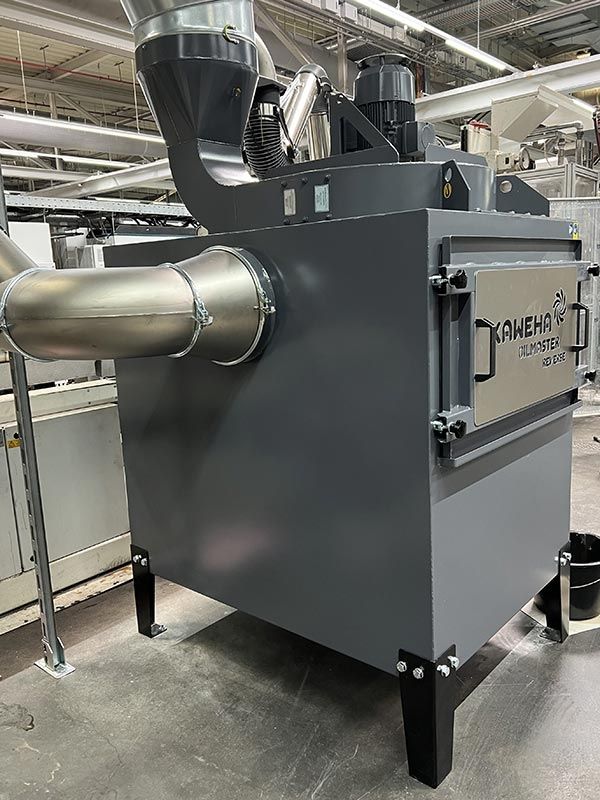
Oil mist is generated quickly whenever CNC tools, EDM machines, or metal drills are used. The problem: This oil and emulsion mist severely pollutes the environment, harms health, and disrupts the work environment. Oil mist filters are available to combat this harmful contamination. Using innovative technologies, they clean the air of these particles – whether in recirculation or exhaust air operation. At KAWEHA, you'll find high-performance oil mist filters of the highest quality.
What are oil mist filters?
Oil mist filters are air purification systems that remove oil mist and oil fumes generated during industrial manufacturing processes. These filters are used wherever machines operate with cooling lubricants or where oil mist is produced as a byproduct. Thanks to specialized filtration techniques, they filter the oil mist from the ambient air, collect the separated oil in containers, and then recirculate the purified air using a fan. This keeps the air clean and creates a hygienic working environment where both employees and machines are completely safe.
How do oil mist filters work?
To remove oil mist and oil droplets from the air, oil mist filters operate with a multi-stage system. Their operation is simple yet effective: An extraction system captures the oily mist at the source and directs it to the filter. A pre-filter first removes all larger particles and droplets before the main filtration stage begins, which consists of several high-performance layers. The subsequent filtration process employs various techniques, such as mechanical filters, electrostatic filters, or centrifugal separators. Mechanical filtration has proven to be the most effective option in recent years in terms of both separation efficiency and service life and is therefore highly recommended.
Through a process called coalescence, the oil droplets combine to form larger droplets within the filter, which can then be collected and removed. In some systems, this is followed by fine filtration with a fine filter that removes even the smallest particles down to 0.3 micrometers with an efficiency of up to 99.97%. Finally, the purified air flows freely through the filters and returns to the work area or to the outside.
That's why oil mist filters are important
Oil mist filters are indispensable in many industrial sectors – and for good reason. They protect the health of all employees by removing harmful aerosols and oil fumes from the air. This creates a clean and safe working environment where the risk of respiratory illnesses or skin rashes is significantly reduced. But it's not just health that benefits: oil mist filters also extend the lifespan of machinery by preventing harmful oil mist deposits and, moreover, reducing maintenance costs.
Furthermore, they help ensure compliance with legal limits for air pollution in the workplace. In many cases, the systems even allow for oil recovery, thus saving costs and protecting the environment. In short: oil mist filters make the workplace safer, cleaner, more sustainable, and more efficient.
Advantages at a glance:
- Protects the health of employees
- Improves air quality
- Complies with occupational safety regulations
- Extends the service life of machines and equipment
- Saves energy by recirculating purified air
- Extracts oil and protects the environment
- Improves product quality
- Protects against fires
- Long-term cost efficiency
These oil mist filters are available
Mechanical oil mist filters are a solid basic solution for all applications. They use physical barriers such as drums, cartridges, bags, or louvers to filter oil droplets from the air. Electrostatic oil mist separators, on the other hand, rely on electrical charges to neutralize and attract the aerosols. For the very smallest droplets, additional HEPA oil mist filters are ideal.
Then there are coalescing filters, which combine mechanical filtration with the coalescing principle. Multi-layer filter systems, often found in high-performance separators, combine various filter technologies and usually have a pre-, main, and post-filter stage. Activated carbon filters are also practical, as they remove odors from the air in addition to oil separation.
Electrostatic oil mist separators vs. Mechanical oil mist separators
Two of the most common oil mist separator technologies are electrostatic and mechanical designs. Mechanical oil mist separators are the ideal solution for industrial applications that value reliability, efficiency, and low maintenance. They are particularly well-suited for coarse oil mist particles from 0.3 micrometers upwards and constant airflows. They filter the aerosols from the air using physical barriers and employ methods such as impaction, interception, and diffusion. Their energy consumption is significantly lower, as only the fan is electrically powered.
Compared to electrostatic oil mist separators, mechanical separators offer several advantages. They utilize robust filter media that operate consistently, even under high particle loads, ensuring stable performance even under demanding conditions. Unlike electrostatic separators, which are notable for their high energy consumption and the complex cleaning of their collector plates, mechanical systems impress with their efficiency and ease of use. Filter replacement is straightforward and requires minimal maintenance. Furthermore, mechanical oil mist separators are far less prone to malfunctions than electrostatic versions, making them ideal for industrial applications.
These are the advantages of mechanical oil mist separators:
- Reliable separation even under heavy particle loads
- Mechanical systems operate with significantly less energy consumption.
- Easy filter replacement reduces effort and saves costs
- Less prone to technical problems and failures
- Use of robust, high-performance filter media
Where are oil mist filters used?
Oil mist filters are particularly common in metalworking, as grinding, milling, and drilling processes often generate large amounts of oil mist. However, oil mist filters are also essential in other industries, such as plastics, textiles, and food processing, for removing harmful fumes and protecting machinery. Furthermore, in the automotive and aerospace industries, where precise and clean working conditions are crucial, oil mist filters offer an effective solution for air purification.
The advantage is that oil mist filters are flexible and can be easily adapted to a wide variety of industrial requirements. In this way, oil mist filters contribute to protecting people and the environment in all industrial sectors, while simultaneously increasing efficiency and productivity.
Oil mist separator from KAWEHA
KAWEHA Absaugtechnik GmbH offers innovative solutions for the reliable extraction of oil and emulsion mists. Our product portfolio includes both stationary and mobile extraction systems that meet the highest standards for health protection, air quality, and environmental impact reduction. With us, you will find:
- Oilmaster OM R (stationary): 1,500 – 100,000 m³/h
- Oilmaster Mini R ST/M (mobile): 600 – 1,500 m³/h
- Special solutions: for example, for fire and explosion protection, sticky dusts and ATEX requirements
Our oil mist separators are flexible and aim to deliver the best results with minimal effort at all times.
How dangerous is oil mist?
Oil mist poses a health and safety hazard in the workplace. The fine, suspended aerosols irritate the respiratory tract with prolonged exposure and can lead to illnesses such as bronchitis, asthma, or even lung damage. The eyes and skin are also affected: dermatitis and irritation are common. In addition, oil mist pollutes the environment, as the fine particles not only settle in the air but can also contaminate soil and water.
KAWEHA oil mist filters: Your solution for clean air
At KAWEHA, we have been developing innovative extraction solutions since 1991 that keep your work environment clean and safe. If you are dealing with oil mist, aerosols, or other pollutants, our custom-designed oil mist filters and extraction systems are the ideal choice. Our products protect your employees, your machinery, and the environment. And the best part: they can be used anywhere, from metalworking and food production to laboratories and specialized manufacturing processes.
Interested in a customized solution? Then contact us today, and together we'll find the perfect oil mist filter for your production!
Frequently asked questions (FAQ)
What does an oil mist filter do?
An oil mist filter removes fine oil droplets and oil mist from the air. This improves air quality in the workplace and protects the health of workers, while simultaneously extending the service life of machinery.
How do oil mist separators work?
Oil mist separators remove oil mist through a filtration process in which the oil droplets are captured, for example, by fibers or membranes, or more easily separated through coalescence.
What is an oil mist separator?
An oil mist separator is a device that selectively removes oil mist from the air. It uses various proven filter technologies to achieve this.
How to detect and measure oil mist?
Oil mist is easily recognizable by its appearance or smell. It is often visible as a fine haze or has a characteristic, strong odor. Special particle measuring devices allow you to precisely determine the concentration and size of the oil droplets. Gravimetric measurements or light scattering methods also help in measuring oil mist.
What is oil mist?
Oil mist consists of microscopically small oil droplets suspended in the air. These droplets are usually smaller than 20 micrometers and are frequently produced during metal processing, lubrication, or spraying.
April 16, 2025
