
Dust explosion: Risks, causes and protective measures
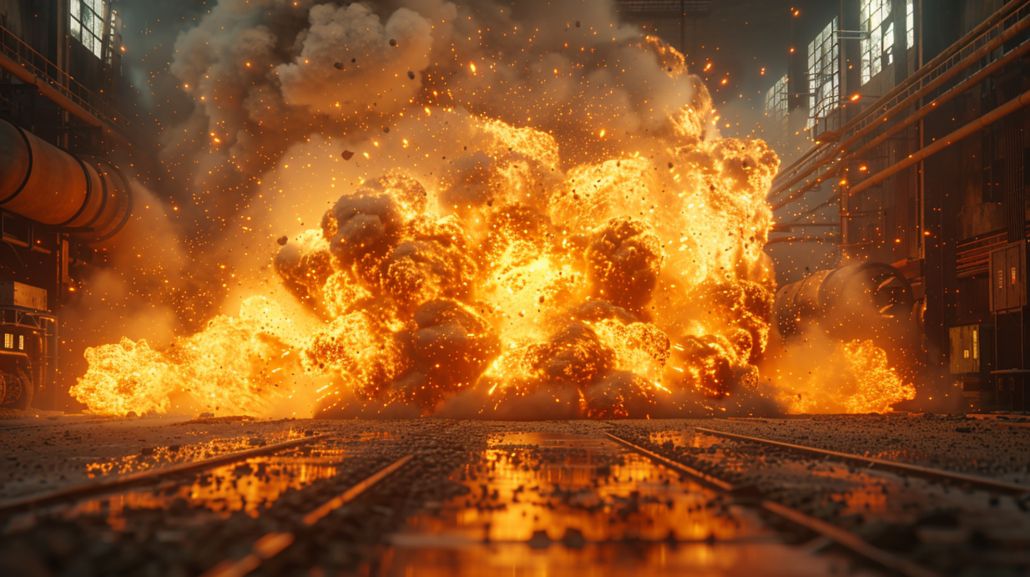
A dust explosion occurs when a mixture of fine, combustible particles and air is ignited by an ignition source. This leads to a sudden, violent combustion. The particle size of the dust plays a crucial role, as only dust particles smaller than 0.5 mm are capable of creating an explosive atmosphere. Such explosions also require sufficient oxygen in the air and an ignition source such as sparks or hot surfaces.
Dust explosions are exothermic reactions in which the rapidly released energy leads to a rapid expansion of the heated gases, causing an explosive release of force. Common triggers are combustible materials such as coal, flour, wood, or metal dust, found in industrial environments like grain mills, wood processing plants, metalworking facilities, and chemical plants. These materials explode within fractions of a second upon contact with an ignition source.
What types of dust explosions are there?
Dust explosions can be classified into different categories, depending on the type of dust, its chemical composition, the explosion characteristics (e.g., MIE – minimum ignition energy, MIT – minimum ignition temperature), and the minimum concentration at which it becomes explosive. The most common types of dust explosions are listed below:
1. Organic dusts
- Wood dust : Fine particles from wood products are explosive at a concentration of 50 g/m³.
- Flour dust : Dust from grain products such as flour can create dangerous explosive atmospheres from 50 g/m³.
- Coal dust : There is a risk of explosion at a concentration of 75 g/m³.
- Cocoa and coffee dust : Although specific values are not always mentioned, these dusts are also considered explosive dusts.
- Sugar dust : Sugar dust becomes explosive at concentrations of 60 g/m³ and above.
- Cellulose dust : This dust can also become explosive under certain conditions; specific values vary.
2. Inorganic dusts
- Aluminum dust : Aluminum becomes explosive at concentrations of 15 g/m³ and above.
- Magnesium dust : A concentration of 850 g/m³ is needed to create explosive conditions.
- Iron dust : There is a risk of explosion at a concentration of 900 g/m³.
3. Fibrous dust
- Asbestos : Although asbestos is primarily harmful to health, explosive conditions can arise under certain circumstances.
- Glass wool : Glass wool can also be explosive when there is a high concentration of fine dust in the air; specific values vary.
4. Other dusts
- Plastic dust : Fine particles made of plastics or resins become explosive at a concentration of 20 g/m³.
- Rubber and cosmetic dust : Dusts from rubber or cosmetics can become explosive under specific conditions; specific values vary depending on the material.
What dust explosion classes are there?
Dust explosion classes are divided into three categories based on the KSt value , which describes the maximum pressure rise rate of an explosion. The following dust explosion classes exist:
- Dust explosion class St 1
- Dust explosion class St 2
- Dust explosion class St 3
1. Dust explosion class St 1
Dust explosion class St 1 includes dusts with a KSt value of 0 to 200 bar·m/s. The KSt value describes the maximum pressure rise rate of a dust explosion, i.e., how quickly the pressure increases during an explosion. Dusts of dust explosion class St 1 cause relatively weak explosions, which can nevertheless be dangerous in industrial environments. Typical dusts of this class are organic materials such as flour or wood, which generate a moderate pressure wave when ignited.
2. Dust explosion class St 2
Dusts with a KSt value between 200 and 300 bar·m/s fall into dust explosion class St 2. These dusts can trigger powerful explosions that can cause significant damage to equipment and injure people. Examples of such dusts are metallic dusts like aluminum or coal dust, which, under optimal conditions, can trigger a very high-energy reaction.
3. Dust explosion class St 3
Dust explosion class St 3 refers to dusts with a KSt value exceeding 300 bar·m/s, which cause extremely powerful explosions. These dusts generate an explosive force that can cause widespread destruction. Metallic dusts such as magnesium are particularly dangerous, as their high energy values result in a very rapid pressure rise.
Who regulates dust explosion classes in Germany?
In Germany, the classification and handling of dust explosions are regulated by various organizations and standards. The VDI (Association of German Engineers) provides comprehensive information on explosion protection for dust explosions in its VDI 2263 guideline. The DGUV (German Social Accident Insurance) publishes the GESTIS Dust Explosion Database, which contains combustion and explosion characteristics of over 7,000 dust samples. Further standards, such as DIN EN 1127-1 and DIN EN 14491, offer detailed specifications for explosion protection and pressure relief in dust explosions.
On what basis is the corporate income tax value calculated?
The calculation of the KSt value (also called dust explosion constant) is based on experimental measurements, specific calculation methods, and normalization to a reference volume. The most important calculation principles of the KSt value are:
- Experimental determination : Determination of values in standardized test apparatus such as the 20-liter sphere autoclave.
- Measurement method : Generation of a dust-air suspension and measurement of the pressure increase after ignition.
- Mathematical calculation and normalization : Application of the formula to determine the maximum pressure rise and scaling to a standard volume of 1 m³.
What are the reasons for the formation of an explosion caused by dust?
Dust explosions in industrial settings result from the interaction of several factors, all of which must be present simultaneously to trigger a dangerous reaction. The following factors contribute to dust explosions in industrial environments:
1. Flammability of the substance
The dust must consist of a combustible material, such as coal, flour, wood, cocoa, coffee, sugar, or starch. These substances, in their fine particle form, are particularly susceptible to ignition, allowing for a rapid reaction upon contact with an ignition source.
2. Particle size of the dust
To create an explosive atmosphere, the dust particle size must be less than 0.5 mm. The smaller the particles, the larger the surface area, which increases flammability and the risk of explosion.
3. Oxygen content in the air
For an explosion to occur, sufficient oxygen must be present in the air to enable the combustion reaction. Without oxygen, the fine dust particles cannot ignite and therefore cannot cause an explosion.
4. Ignition source
An ignition source, such as sparks, flames, or hot surfaces, is required to ignite the dust-air mixture. Even the smallest spark can trigger a massive explosion under the right conditions.
5. Enclosed space
Explosions often occur in enclosed spaces because the pressure wave and fire can spread more rapidly, significantly increasing the intensity and damage of the explosion. A secondary explosion can also occur if a primary explosion dislodges debris, creating a new, explosive atmosphere.
6. Concentration of the dust
The concentration of dust in the air must be high enough to create an explosive atmosphere. Depending on the type of dust, this can range from 60 to 2000 grams per cubic meter of air. So-called hybrid mixtures, which are a combination of combustible dusts and gases, can also pose a significant explosion hazard.
7. Dust deposits
Dust deposits on surfaces pose a significant risk, as they can be stirred up by air currents or vibrations, creating an explosive atmosphere. Regular cleaning intervals and the use of specialized industrial vacuum cleaners are recommended to minimize this risk. Regular removal of these deposits can significantly reduce the risk of explosion.
In which industries can dust explosions occur?
Dust explosions can occur in various industries that work with combustible dusts. Some industries are particularly at risk because they handle fine, flammable materials that are easily ignited. The following are among the most vulnerable industries.
Food industry
The food industry is at high risk because it handles dusts such as flour, sugar, cocoa, and other dry food products. These fine particles can form explosive atmospheres in the air and lead to serious accidents.
Woodworking
Wood processing produces fine wood dust, which, at sufficient concentrations and with an ignition source, can lead to dangerous explosions. The risk is particularly high in enclosed spaces.
Metalworking
Metal processing poses a high risk of explosion due to the generation of metal dust, especially aluminum and magnesium dust. This dust is extremely fine and flammable, which further increases the danger.
Agriculture and grain processing
Grain processing produces grain dust, which is explosive in high concentrations. Silos and grain mills pose a high risk due to the trapped dust and potential ignition sources.
Chemical and pharmaceutical industry
These industries frequently work with combustible dusts, which can be generated by chemical reactions or mechanical processes. These dusts are often highly flammable and pose a significant explosion risk.
Recycling plants
Recycling plants process a wide variety of materials, which can release flammable dust during shredding and processing. The risk of a dust explosion is therefore increased in these plants.
Coal mining and processing
Coal mining and processing produce coal dust, which is highly flammable in certain concentrations and can cause severe explosions.
What are the legal requirements for explosion protection in Germany?
The legal requirements for explosion protection in Germany are regulated in several ordinances and guidelines. Key regulations, such as the Hazardous Substances Ordinance (GefStoffV), require a hazard assessment and the preparation of an explosion protection document. The Industrial Safety Ordinance (BetrSichV) stipulates that equipment in potentially explosive atmospheres must be inspected and maintained. Furthermore, the ATEX Directives 2014/34/EU and 1999/92/EC play a role, as they prescribe the classification of work areas into Ex zones and the use of explosion-proof equipment.
The German Explosion Protection Ordinance (11th ProdSV) transposes these ATEX requirements into German law. These are supplemented by the Technical Rules for Hazardous Substances (TRGS) and Operational Safety (TRBS), which prescribe measures for the safe operation and maintenance of equipment. The DGUV regulations also contribute to explosion protection by defining industry-specific requirements for the preparation of safety documentation.
What are explosion protection documents?
An explosion protection document is a document prepared as part of the hazard assessment according to Section 6 Paragraph 9 of the Hazardous Substances Ordinance (GefStoffV) and identifies and evaluates hazards posed by explosive mixtures. It contains an explosion protection concept that describes technical and organizational measures to prevent explosions or their effects.
A key component is the zoning of areas where explosive atmospheres may occur, as well as the definition of protective measures against fire and explosion risks. Furthermore, cooperation with other companies is regulated to avoid conflicts, and all testing of the protective measures is documented. This document meets the legal requirements of the German Hazardous Substances Ordinance (GefStoffV).
How do industrial extraction systems prevent dust explosions?
Industrial extraction systems play a crucial role in preventing dust explosions by removing combustible dust from the air and preventing the formation of an explosive atmosphere. One example is a central extraction system with filter units, used in woodworking to continuously extract wood dust and minimize the risk of explosion.
A key function is dust separation, which filters hazardous particles from the air. Extraction systems can be equipped with explosion pressure relief systems that release the pressure generated in an explosion in a controlled manner, preventing major damage. Another component is explosion isolation, which ensures that an explosion does not spread to adjacent areas. Further protective measures include explosion suppression, which detects and stops the explosion at an early stage, and isolation, which prevents explosions from propagating.
Many extraction systems are equipped with fire extinguishing systems that activate automatically in the event of an explosion. Regular maintenance is essential for these systems to function optimally. Furthermore, the systems must comply with ATEX directives to operate safely in potentially explosive atmospheres. Testing the explosion characteristics of the dusts used and conducting a system-specific safety assessment are crucial to ensuring an optimal protection concept.
Can concrete dust cause a dust explosion?
No, concrete dust is not explosive. For a dust explosion to occur, the dust must consist of combustible material that can react exothermically with oxygen. However, concrete dust consists of already fully oxidized compounds such as silicon dioxide, calcium carbonate, and aluminum oxides. These inert materials cannot undergo any further oxidation reactions and therefore offer no explosion potential.
How does a flour dust explosion occur?
A flour dust explosion occurs when fine flour dust suspended in the air is ignited by an ignition source, triggering an explosive chain reaction. The microscopic flour particles, with their high surface area, increase their contact with oxygen, thus increasing their reactivity. The resulting rapid combustion releases heat and gases, creating a pressure wave that, in turn, stirs up new dust particles and amplifies the explosion.
Can sugar dust cause an explosion?
Yes, sugar dust can cause an explosion if certain conditions are met. For a sugar dust explosion to occur, combustible sugar dust, oxygen from the air, a fine dispersion of the dust, and an ignition source such as an open flame or electrostatic discharge must all interact. Sugar dust is particularly dangerous because it easily breaks down into fine dust and is often stored in large quantities, which increases the risk of secondary explosions.
Does wood dust also pose a risk of explosion?
Yes, wood dust can pose a significant explosion hazard when it is finely dispersed in the air and comes into contact with an ignition source. This danger arises because wood dust consists of flammable organic compounds such as cellulose, hemicellulose, and lignin, which are highly flammable. When wood dust with particle sizes below 500 micrometers is stirred up by air circulation, a dust-air suspension forms, which is explosive at a concentration of 50 to 500 g/m³.
October 11, 2024
